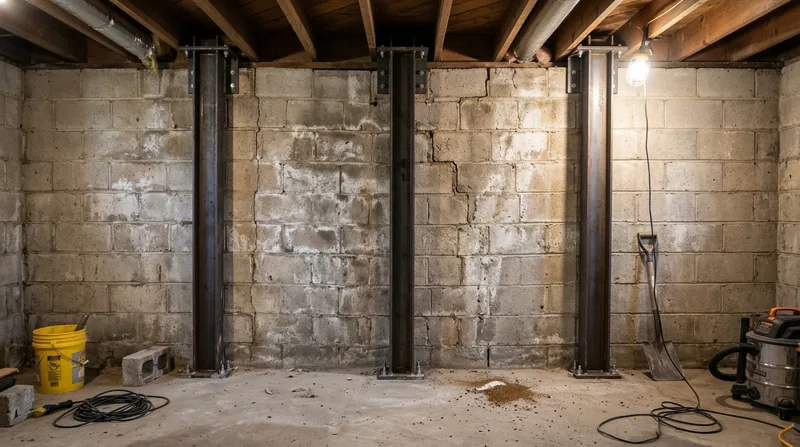




Bowing Wall Repair in Joliet: Stopping the Lean Before It Spreads
When a basement wall starts to lean inward, the cause is almost always outside the house. In Joliet, that means bowing wall repair in Joliet work driven by saturated glacial clay pressing against older block and brick walls, especially on the Southside bungalows and the 1880s-1930s homes near the Des Plaines River. The clay takes on water during spring thaw and April storms, expands, and pushes. Freeze-thaw winters then work the same wall every year. We stabilize the wall, correct the movement where it can be corrected, and address the water and soil pressure behind it so the repair holds. If you are seeing a horizontal crack in the middle of a block wall or a wall that has pulled away from the floor joists, start with a free basement inspection before the movement gets worse.
Why Bowing Walls Show Up So Often in Joliet's Older Neighborhoods
Joliet sits on thin glacial till over Silurian dolomite bedrock, the same limestone quarried around Lockport. In low ground near the river and its tributaries, the water table stays high, and fractured rock gives water a fast path to the footing. Older stone, brick, and early block walls were never designed for that kind of hydrostatic pressure. The result is the classic inward bow, often with a horizontal crack at mid-height and efflorescence blooming on the inside face.
- Hydrostatic pressure builds when saturated clay soil cannot drain and pushes laterally against the wall.
- Clay footing drains from the 1920s and 1930s collapse or silt in, so water pools at the base of the wall instead of running away.
- Freeze-thaw cycles open existing cracks wider each winter and let more water into the wall core.
- Downspout and grading issues dump roof runoff right against the foundation instead of carrying it away.
Each of these adds load to a wall that is already carrying more than it was built for. The fix has to address the pressure, not just the crack you can see.
Key info: A 1950s brick bungalow off Black Road showed a 2-inch inward bow with a horizontal crack running the length of the wall. The cause was a failed clay footing drain and a downspout discharging within 18 inches of the foundation. Carbon fiber straps plus a corrected discharge line stopped the movement without exterior excavation.
For the structural side of the work, the City of Joliet Building Department is the authority on permits and inspection requirements, and rules vary by jurisdiction: City of Joliet official site.
How We Diagnose and Repair a Bowing Wall in Joliet
We do not quote a repair from a photo. The first step is measuring the actual movement: plumb reading at the top, middle, and bottom of the wall, crack width, and how the wall meets the floor and joists. Then we check the soil and drainage conditions outside, because a wall that keeps taking on water will keep moving no matter what we bolt to it. The repair method follows the severity, not the other way around.
- We measure the bow and record crack widths so we have a baseline to compare against later.
- We inspect the exterior grade, downspouts, and footing drain to find where the water is coming from.
- We recommend the right system: carbon fiber straps for light to moderate movement, steel I-beams for heavier loads, wall anchors where the soil allows.
- We install the system, seal active cracks with epoxy or polyurethane injection as needed, and correct the drainage that caused the problem.
- We schedule a follow-up reading so you can see whether the movement has stopped.
On a 1970s split-level in Crest Hill, the wall had bowed about an inch and a half with no horizontal crack yet. Carbon fiber straps on 4-foot centers plus a foundation crack repair on two vertical cracks handled it, and the follow-up reading six months later showed no further movement.
Key info: A poured walkout basement in Shorewood had a wall leaning inward at the top. The soil on the slope was saturated from a spring thaw and the downspouts dumped right at the corner. Wall anchors pulled the top back to plumb over several weeks, and extending the downspouts past the slope kept it there.
Not every bow needs anchors or beams. If the movement is under a quarter inch and the wall is otherwise sound, monitoring plus moisture control may be the honest answer.
Repair Methods We Use
| Approach | Description | Best for |
|---|---|---|
| Carbon fiber straps | High-strength straps epoxied to the inside face of the wall, floor to joist, to resist further inward movement. | Light to moderate bowing on block or poured walls with no active water problem. |
| Steel I-beams | Vertical steel beams set against the wall and anchored into the floor and overhead structure. | Heavier movement or walls that need a stiffer, more robust brace. |
| Wall anchors | Anchor plates set in the soil outside, connected through the wall to inside plates that pull the wall back toward plumb. | Walls leaning at the top where the soil outside can hold an anchor. |
| Epoxy or polyurethane injection | Injection ports set along the crack, then resin pumped in to fill and seal it. | Active cracks that need sealing in addition to structural bracing. |
The structural brace and the crack seal work together. One stops the movement, the other keeps water out of the wall.
Bowing Wall Repair Cost in Joliet: What to Expect
Pricing for bowing wall repair starts at $600 for a straightforward crack injection or a small strap installation, and moves up from there. The number depends on how far the wall has moved, how long the wall is, and what the soil is doing outside. A single wall in a Crest Hill ranch is a different job than a full basement perimeter in an 1890s brick home near downtown.
- Wall length and height drive how many straps, beams, or anchors the job needs.
- Severity of the bow decides whether straps are enough or whether anchors or beams are required.
- Access to the wall inside the basement affects labor time, especially in finished or cluttered spaces.
- Drainage corrections like downspout extensions or footing drain work add to the scope but are often what keeps the repair from failing.
Get two or three written estimates and compare the scope, not just the total. A low number that skips the drainage correction is not the same job. See the full pricing overview for detail on how we build an estimate.
Hiring a Bowing Wall Repair Contractor Near Me in Joliet: What to Check
Structural repair is not the place to hire the low bid from a door-knocker. Ask for the license and insurance certificate before anyone touches the wall, and confirm the policy covers foundation work, not just general handyman tasks. Get at least two written estimates with the method spelled out, and ask for references from jobs in Joliet or the surrounding towns. Permits are commonly required for structural foundation repair, and the City of Joliet Building Department sets the thresholds, so confirm who pulls the permit before work starts.
A contractor who cannot explain why your wall is bowing, not just what they will bolt to it, is guessing. We walk you through the readings and the drainage findings so the recommendation makes sense. Reach out through our contact page to schedule an inspection.
Bowing Wall Repair in Joliet: Pricing Guide
| Service | Price | Details |
|---|---|---|
| Crack injection (epoxy or polyurethane) | Starting at $600 | Includes port installation and resin injection on a single accessible crack, price rises with crack length and access. |
| Carbon fiber strap installation | Starting at $1,200 | Includes straps on standard spacing floor to joist, number of straps and wall length move the price. |
| Steel I-beam or wall anchor system | Starting at $3,500 | Includes beam or anchor installation for heavier movement, soil condition and wall length drive the total. |
| Full wall stabilization with drainage correction | On estimate | Needs an on-site look at the wall readings, footing drain, and exterior grade before a number is given. |
| Travel | Included | In Joliet and surrounding areas, no separate call-out or mileage fee. |
| Estimate | Free | Response within 24h at (815) 768-2601, no obligation to book. |
Indicative pricing, the exact cost depends on square footage, finish, and site access. Free personalized estimate within 24h at (815) 768-2601.


