The Geology Under Your Feet: Joliet Dolomite Soil Explained
Most homeowners never think about what lies beneath their lawn until water starts seeping into the basement. In Joliet, the story underground is unusual, and it has a direct effect on how water behaves around your foundation. The area sits on a layer of dolomite, a hard limestone-like bedrock that formed hundreds of millions of years ago. In many parts of town, the soil covering that bedrock is surprisingly thin, sometimes only a few feet deep before you hit solid rock.
That combination of thin till and shallow dolomite is what we call Joliet dolomite soil, and it changes everything about drainage. Normally, rainwater soaks down through deep soil and slowly dissipates. Here, water hits the rock shelf quickly and has nowhere to go but sideways, along the top of the bedrock, straight toward the path of least resistance. More often than not, that path leads to your foundation wall. Understanding this is the first step toward solving recurring basement leaks in Joliet, because the fix has to account for the geology, not just the crack you can see.
Why Thin Till Over Limestone Bedrock Pushes Water Toward Foundations
When rain falls on a yard with deep, absorbent soil, most of it perches in the dirt and evaporates or is taken up by plants. When rain falls on thin till over limestone bedrock, the water saturates that shallow layer fast, then spreads laterally across the impermeable rock. During a heavy spring storm or a rapid snowmelt, the rock shelf acts like a giant underground funnel aimed at the lowest point around your house, which is usually the basement. This is the core reason limestone bedrock water problems show up so often in this region.
There is a second factor at work too. Dolomite does not stay pristine. Over time, water dissolves small seams and voids in the rock, creating pathways that can channel water from surprisingly far away. That means a wet basement in one neighborhood block might be fed by runoff from a rise several lots uphill. Homeowners often blame a single downspout or a bad gutter, when the real source is the bedrock plumbing beneath the whole street. A proper assessment looks at the site as a system, not just the visible damp spot on the wall.
Illinois Foundation Cracks and Soil Movement: What Homeowners Notice First
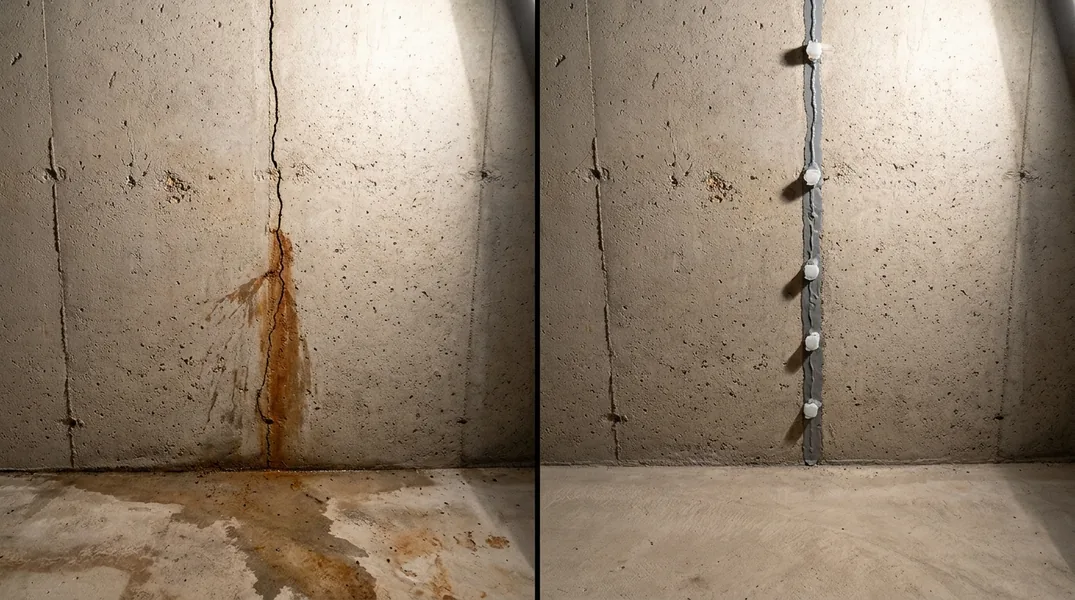
The visible symptoms of this geology usually appear as Illinois foundation cracks, and they tend to follow predictable patterns. You might see stair-step cracks in a block wall, a horizontal crack near the frost line, or a hairline crack that widens every spring. These are not random defects. They are the result of soil movement, as the shallow till expands when wet and shrinks when dry, repeatedly flexing the foundation. Dolomite bedrock underneath adds its own pressure, and the concrete or block wall absorbs the stress until it cracks.
Soil movement also shows up in ways that are easy to miss. Sticking doors and windows, gaps around the frame, or a floor that feels slightly uneven can all point to the same underlying issue. When water saturates the thin soil and then drains away through bedrock seams, the ground can settle unevenly, and your foundation follows. Catching these signs early matters, because a small crack is far easier and less expensive to address than a wall that has bowed or a basement that floods every time it rains. If you notice any of these patterns, it is worth having a professional take a look before the next wet season.
Basement Leaks in Joliet: Why the Usual Fixes Fall Short
Many homeowners try the obvious solutions first: patching the crack from inside, painting the wall with a sealer, or extending a downspout a few extra feet. These steps can help at the margins, but they rarely solve basement leaks in Joliet that are driven by bedrock hydrology. Interior crack patching stops the water where it enters, but it does not relieve the pressure building behind the wall. Over time, that pressure finds another path, and you are back to square one with a new leak in a different spot.
What actually works is managing water before it reaches the foundation and giving it a controlled way to leave. That is where a real Basement Waterproofing strategy comes in. Depending on your situation, an Interior Drain Tile System can capture water at the base of the wall and route it to a sump, while Exterior Basement Waterproofing addresses the problem from the outside by improving drainage and sealing the wall where the soil meets it. For homes with significant structural stress, Foundation Waterproofing combines crack repair with water management so the wall is protected on both sides.
Basement Waterproofing Near Me: When to Call a Local Pro
If you have tried the DIY fixes and water still finds its way in, it is time to bring in someone who understands the local ground. A contractor from out of the area may recommend a generic solution that works fine on deep Midwestern clay but misses the bedrock dynamics that make Plainfield and Shorewood homes behave differently from properties farther south. A local professional will evaluate your grading, your soil depth, the condition of your foundation, and the drainage patterns around your whole lot before recommending anything.
It also helps to know when to act. Recurring dampness, efflorescence (the white powder on basement walls), musty odors, and water stains that reappear after every storm are all signals that the current setup is not keeping up. Waiting usually makes things worse, because repeated wetting and drying cycles widen existing cracks and weaken the foundation over time. A thorough inspection now can save you from a much larger repair later. You can reach Joliet Waterproofing at (815) 768-2601 to schedule a free estimate and get a clear picture of what is happening under your home.
Basement Waterproofing Cost in Joliet: What to Budget
Homeowners understandably want a number before they commit, but honest pricing depends on several variables. The size of your basement, the type of foundation, the severity of the cracking, and whether you need interior drainage, exterior work, or both all affect the total. A single crack repair is a very different project from a full perimeter drain tile installation with a sump system. Because the dolomite soil here can create water paths that are hard to predict from the surface, a proper quote requires an on-site evaluation rather than a phone estimate.
What we can say is that addressing a problem early is almost always cheaper than waiting. A small crack that is sealed and managed today may prevent a flooded basement, ruined flooring, and mold remediation down the road. If you are comparing bids, be wary of any contractor who quotes a price without inspecting your foundation and grading, or who promises a one-size-fits-all fix. Ask what specifically is being done about the bedrock water and soil movement on your lot. For a straightforward conversation about your home and a free estimate, call Joliet Waterproofing at (815) 768-2601 or visit joliet-waterproofing.com. We serve Romeoville and the surrounding communities, and we know this ground well.
Looking for a professional basement waterproofing contractor in Joliet? Joliet Waterproofing responds fast for all your basement waterproofing needs.
Get a Free QuoteOur services: Basement Waterproofing · Interior Drain Tile System · Exterior Basement Waterproofing